Lectures
You can download the lectures here. We will try to upload lecture slides prior to their corresponding classes.
-
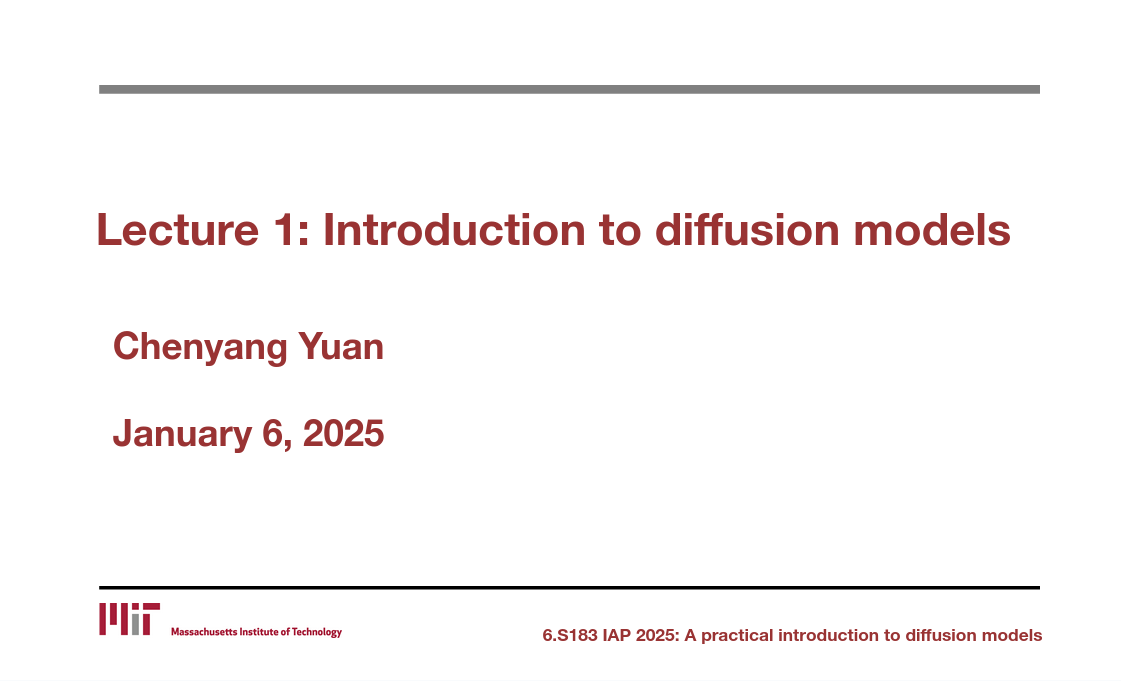 Lecture 1: Introduction to diffusion models
[slides] [video] [feedback]
- What are generative models?
- Applications of generative models
- A brief history of generative modeling, from VAEs to GANs to Diffusion.
- What are diffusion models?
Suggested Readings:
-
 Lecture 2: Perspectives on diffusion
[slides] [video] [feedback]
- Introduce different interpretations and perspectives on diffusion
- Derivation of DDPM and DDIM, SDE reversal and probability flow ODE.
- Fokker-Planck and connections to physics.
Suggested Readings:
-
 Lecture 6: Model generalization, summary and conclusion
[slides] [video]
- Why do diffusion models generalize?
- Inductive biases of diffusion models: training and architecture.
- How to train better and focus on noise levels that matter most.
Suggested Readings:
- Interpreting and improving diffusion models from an optimization perspective
- Generalization in diffusion models arises from geometry-adaptive harmonic representations
- Closed-Form Diffusion Models
- Nuclear Norm Regularization for Deep Learning
- An analytic theory of creativity in convolutional diffusion models